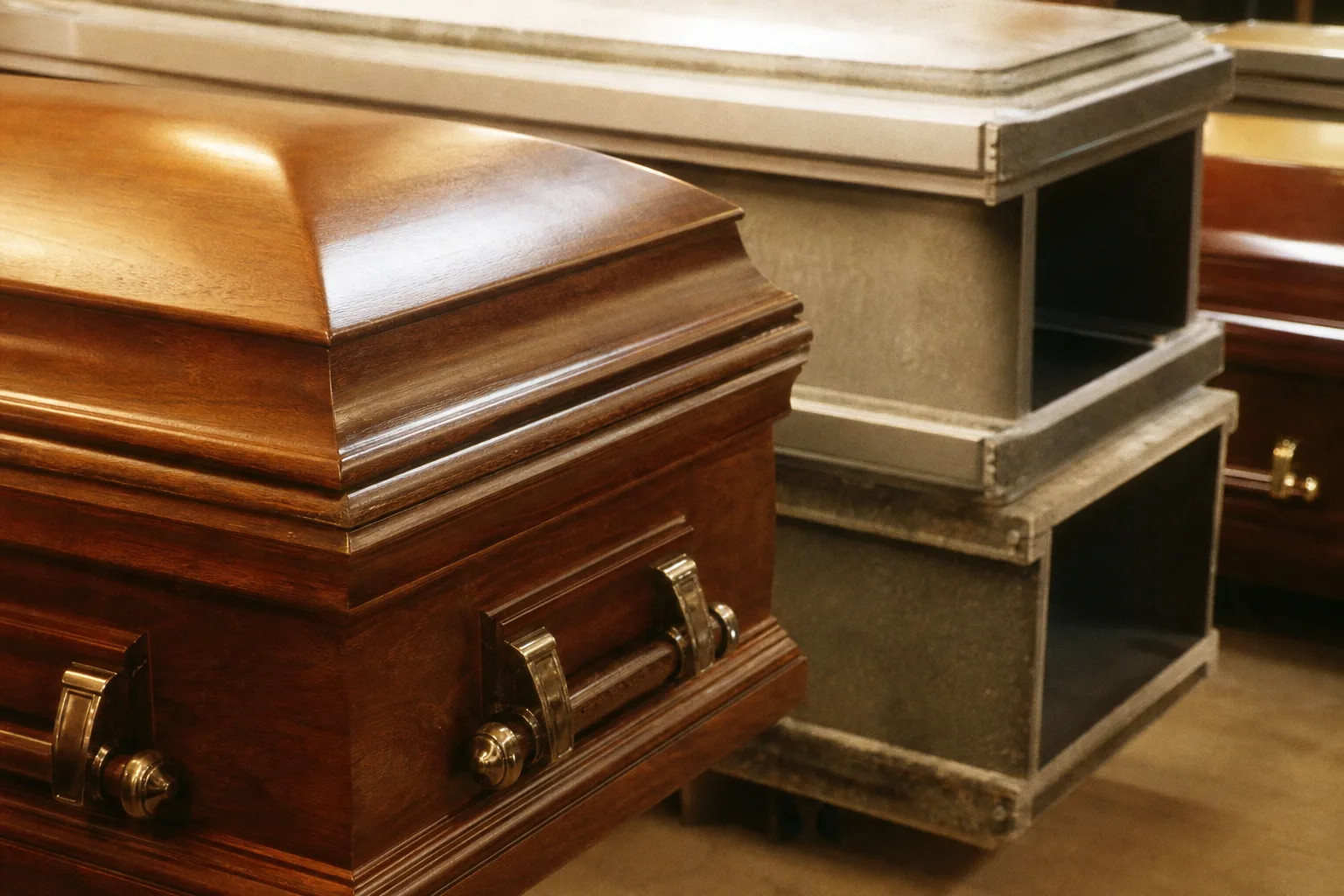
A funeral director hands you a catalog, or walks you into a room of half-caskets mounted on the wall, and the question on the table is what the box is made of. That is the wrong first question, and answering it first is how families end up with a container that the cemetery will not accept as delivered, or one built for conditions it will never encounter. The destination sets the requirements. Ground, retort or crypt, each imposes a different short list, and once you name the one you are using, most of the catalog stops applying.
In-ground burial: the grave has rules the casket does not
A grave in a maintained cemetery almost always requires an outer container, a concrete box or vault set into the excavation to keep the ground from settling as the casket and the soil above it work against each other. That requirement belongs to the cemetery, not to any state law, and it is the single item most likely to surprise a family that priced only the casket. The outer container is a separate purchase with its own price range, from an unlined concrete grave box at the low end to a lined and sealed vault several times that. Ask for the cemetery's written rule sheet before you agree to anything, because the sheet names the minimum, and the minimum is often all you need.
Once the outer container is settled, the casket itself has fewer jobs to do than the sales floor implies. It has to hold together through the visitation, the service and the committal, it has to fit the vault's interior dimensions, and it has to be liftable by six people. Twenty-gauge steel, poplar, oversized widths for a broader body: those are real distinctions with real consequences. Sealing gaskets, protective warranties and interior upgrades are choices, not requirements, and the Federal Trade Commission oversees how funeral providers must present and price them.
Cremation: the container is consumed, or it is temporary
If the body is going to a crematory, the container has one functional requirement and one procedural one. It must be rigid and combustible, capable of being handled and moved with the deceased inside, and it must be leak resistant. That is a cremation box: heavy corrugated fiberboard or an unfinished softwood tray, priced in the low hundreds rather than the low thousands. No crematory needs hardwood, hardware or a gasket, and burning them adds nothing except cost and a slower cycle.
The complication is the service. Families who want an open-casket visitation before cremation are usually offered a rental casket, an outer shell with a removable inner container that goes to the retort while the shell stays behind. The rental fee is a fraction of the purchase price of the same casket, and it solves the problem of paying four thousand dollars for something that exists for six hours. If a full casket is being cremated anyway, the six-sided tapered shape sold as a Coffin uses less material than a rectangular casket, which is a small saving, not a large one.
Above-ground entombment: the crypt is the constraint
A mausoleum crypt is a fixed opening in a concrete or granite structure, and the casket has to slide into it. That is a dimensional problem before it is a material one. Crypt interiors vary by mausoleum and sometimes by row within the same building, so the cemetery's stated interior width, height and length are the numbers that matter, and an oversized casket that fits a grave comfortably may not fit a crypt at all. Confirm the measurement in writing, and confirm it against the specific crypt you are buying, not the building's general specification.
Entombment also changes what the container is doing. There is no soil load and no outer container, so the vault question disappears entirely, along with several hundred to a couple of thousand dollars. Many mausoleums require a sealed casket, and some require a specific material class, usually metal, because of how the crypt space handles what happens inside it. Those are legitimate written requirements rather than upsells, and the cemetery will give them to you plainly if you ask.
What the sorting actually saves
Naming the destination first collapses the decision in a way that shows up directly on the itemized price list. Cremation removes the outer container line entirely and puts the container itself in the hundreds. Entombment removes the outer container but may add a sealing requirement to the casket. In-ground burial keeps both lines and makes the cemetery's minimum the number to work from. Each path leaves three or four real options, and once the list is that short, comparing them on wood species or steel gauge becomes a manageable question instead of an overwhelming one.
The order also protects against a specific and common error, which is buying an expensive container for a service that does not require it, then discovering the cemetery requirement afterward and having to fund it on top. Funeral providers must give you an itemized general price list, and a cemetery will provide its rules on request, usually as a single page. Reading both before you look at any merchandise takes maybe twenty minutes. It routinely changes the total by more than any other twenty minutes in the process.
Start with the piece of ground, the retort schedule or the crypt number, get the written requirements attached to it, and then walk into the selection room already knowing which half of it does not apply to you.