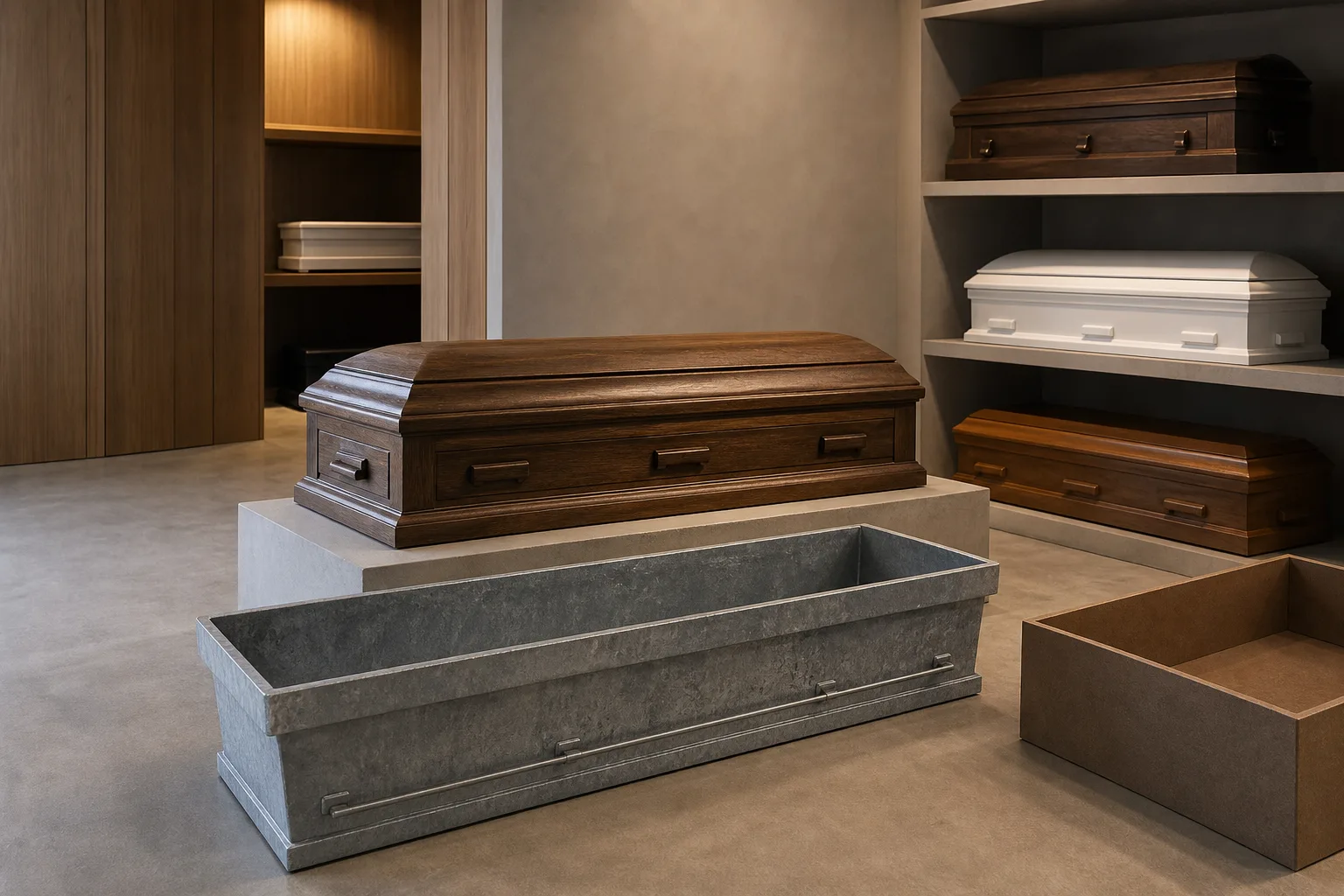
A family arranging cremation or a natural burial is often quoted a casket first and told about the alternatives second, which reverses the order in which those decisions actually get made. The crematory has a written policy about what it will put in the chamber, and the conservation burial ground has a written policy about what it will put in the ground, and both of those documents exist before anyone opens a casket catalog. Read them first. The container that satisfies the operator is usually cheaper, lighter and easier to obtain than the one on display, and the difference runs into real money.
1. The rigid combustible box, and what rigid actually means
Nearly every crematory in the country requires a container, and nearly every one of them describes it in the same three terms: rigid, combustible, and leak resistant. Rigid is the word that gets tested. A corrugated box that flexes when two people carry it loaded is not going to survive a transfer from a cot to a charging table, and the operator who has to deal with that failure is the one writing the policy. Look for a base of solid wood or heavy laminated board, cross-bracing under the floor, and either cut handholds or rope handles rated for the stated weight limit.
2. Rental caskets, and the inner shell doing the real work
A rental casket is a hardwood or veneered shell with a removable interior, used for a viewing or a funeral service and then reused. What goes into the cremation chamber is the inner container, typically a rigid combustible box with its own liner and its own bed, which slides out through the foot end or lifts out from the top. Ask which of the two designs the funeral home stocks, because an end-loading unit handles more gracefully in a tight chapel. Ask also what the rental fee covers, since the inner container is frequently a separate charge on the price list.
3. Shrouds, boards, and the weight of a loaded carry
Conservation and natural burial grounds generally accept a shroud alone, and most of them accept a shroud on a carrying board, which is a plank of untreated wood with hand slots or rope handles along both edges. The board is what makes the burial manageable. Six people lowering a shrouded body on webbing straps need something under it to keep the load flat and the movement controlled, and grounds that have done a few hundred of these will say so plainly in their guidelines. Check the fiber content: unbleached cotton, linen, hemp and wool are standard, and synthetic thread in the seams is commonly refused.
4. Unlined graves, and the rule sheet that permits them
An unlined grave has no vault, no grave liner, and no concrete of any kind, which is the entire point of a conservation burial ground and the reason it can price a plot without an outer container in it. Conventional cemeteries that offer a natural section will say in writing whether the liner requirement is waived there, and that sentence is worth finding before the plot is bought. Some grounds also cap total burial depth and set a minimum spacing between graves, both of which affect what container geometry will fit. Get the dimensions in inches, not in adjectives.
5. What a careful reader checks before signing
Five things settle almost every dispute. The interior dimensions and the rated weight capacity, stated as numbers by the manufacturer rather than estimated by a salesperson. The presence of any metal: hinges, screws, staples, corner brackets, and whether the operator wants them removed. The moisture barrier, which on a combustible box is usually a plastic or wax-treated liner and on a shroud is a separate absorbent layer. The handling method, meaning who lifts it and from where. And the price as it appears on the general price list, since the Federal Trade Commission oversees how funeral providers disclose prices for caskets and alternative containers, and an itemized list should exist on request.
The pattern that emerges from reading enough of these policies is that operators care about handling, not appearance. A box that carries cleanly, holds its shape under load, and contains fluid will be accepted almost anywhere, and a shroud of natural fiber on a solid board will be accepted at any ground that permits shrouds at all. Confirm both in writing, ideally by email, with the operator's own name on the reply.