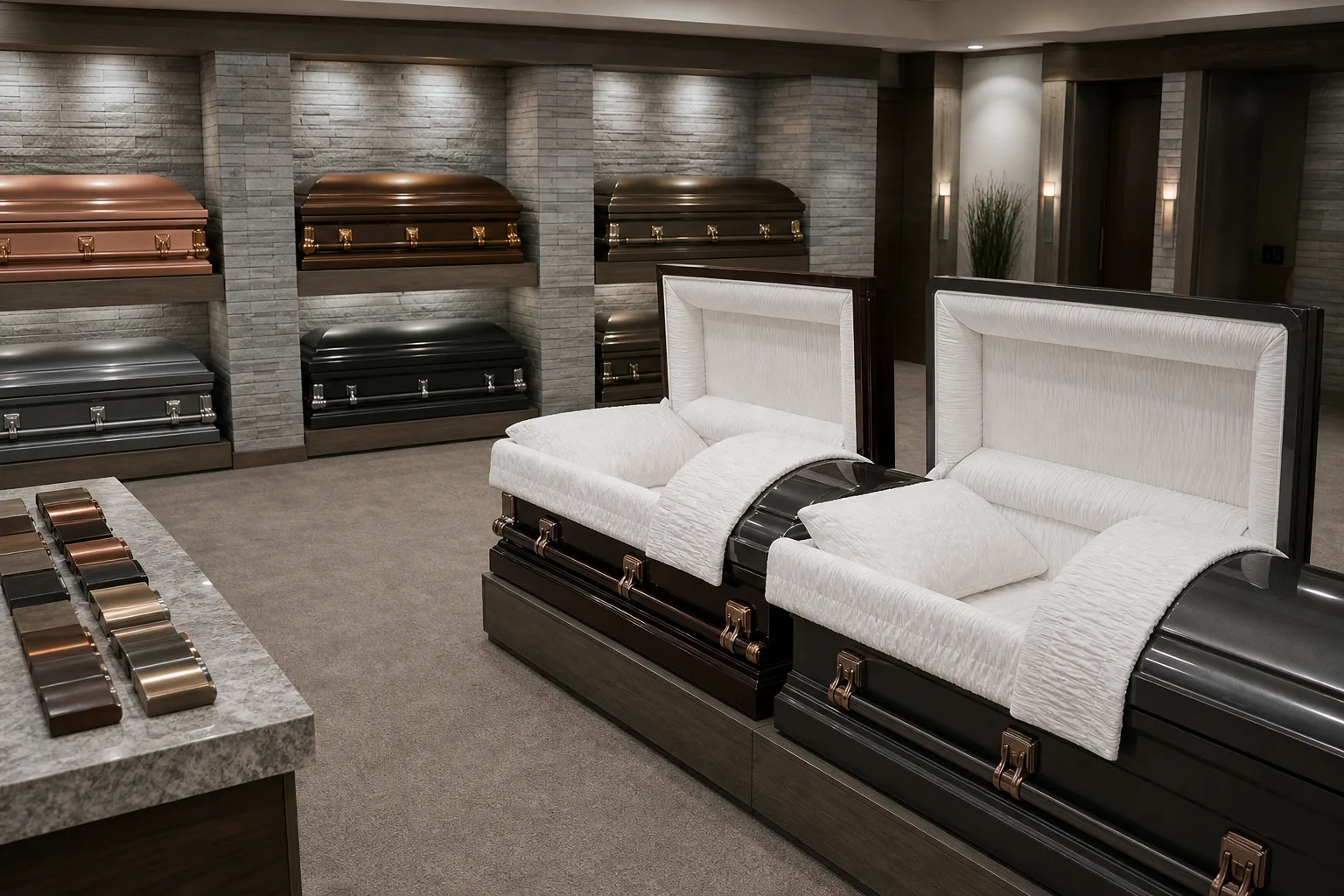
Two caskets sitting side by side in a selection room can differ by two thousand dollars and look, to anyone who has not spent a career around them, essentially identical. Same shape, same shirred interior, same swing bar handles. The difference is written on the card taped to the corner, in a shorthand that nobody explains because the people who wrote it assume you already read it. Learning that shorthand takes about ten minutes, and it is the single highest-value ten minutes a family spends during an arrangement conference.
Start with the gauge number, and remember it runs backwards
Steel caskets are described by gauge, and the scale is inverted: 20 gauge is thinner than 18, which is thinner than 16. A 16 gauge box uses noticeably more steel than a 20 gauge box of the same dimensions, which is most of why it weighs more, costs more, and feels more solid when you press on the lid. Stainless steel gets its own line, usually with a grade attached. Copper and bronze are not measured in gauge at all but in ounces per square foot, commonly 32 or 48, and those are a different price tier entirely.
Wood is described by species, and the honest cards say so plainly: poplar, pine, ash, oak, cherry, walnut, mahogany. What a careful reader checks next is whether the card says solid or veneer, because a mahogany veneer over a hardwood core and a solid mahogany shell are separated by a great deal of money and very little visible difference. Ask which one is in front of you. Nobody will refuse to tell you, and the answer is often already printed in small type at the bottom of the card.
What 'protective' and 'sealed' are actually describing
These words describe a piece of hardware, not an outcome. A protective or sealed casket has a continuous gasket, usually rubber or a butyl-type compound, seated in a channel around the rim, plus a locking mechanism that draws the lid down against it, typically operated by a crank key that is handed to the family or retained by the funeral home. That is the whole apparatus. It resists the entry of outside air and water for some period, and manufacturers describe it in exactly those terms if you read the warranty rather than the brochure.
The distinction matters because the two words sound like they are promising something about the person inside, and they are not. The Federal Trade Commission oversees funeral sales practices in the United States and is responsible for the rules governing what may be claimed about caskets and their effects. Sellers are not permitted to tell you that a casket will preserve remains. If a spec card, a salesperson, or a website drifts toward that suggestion, the drift is the thing to notice, and asking for the claim in writing usually ends it.
What the gasket does once the grave is closed
Below ground, a sealed unit does what a sealed container does anywhere: it slows the exchange between inside and outside. Decomposition is not driven by soil contact, it is driven by processes already present, and those continue in a closed environment, often anaerobically, which produces gas. Manufacturers and vault makers know this, which is why outer burial containers are commonly built with a way for pressure to equalize rather than being airtight themselves. Nothing about that is a defect. It is the design responding to physics that was never optional.
Read the warranty, because it is the plainest document in the room
A casket warranty typically covers the casket, against defects in materials and workmanship, for a stated number of years, sometimes conditioned on burial in a sealed outer container from the same maker. It covers the object. It says nothing about the condition of remains, and no manufacturer in the American market warrants preservation, because none of them can. Read it before you choose, not after. It is one page, it is written in ordinary sentences, and it tells you exactly what your money bought with more candor than any other paper you will be handed.
Once you know the gauge scale, the difference between solid and veneer, and where the warranty stops, the price ladder in a selection room stops being mysterious and becomes a set of choices you can make on your own terms, for whatever reasons matter to you.